Buyers find and choose engineering suppliers very differently than they used to. Reputation alone won’t carry you ahead of competitors who are showing up online while you’re still relying on word of mouth. A modern marketing strategy for engineering companies needs to account for that shift – not random digital channels added on top, but a coherent plan that actually fits how your buyers research and decide.
If you’re a marketer or owner in an engineering company and you want to learn how to reach more of your ideal customers (especially online), then this guide will help with exactly that – from the perspective of a marketing agency that primarily serves businesses in this space.
We’ll cover the key differences between engineering marketing and marketing for other businesses, what a modern engineering marketing strategy looks like, and go into detail about how to build a strategy that works for you.
Why marketing strategies for engineering companies are different
Building a marketing plan for an engineering company isn’t the same as building one for any other industry. Several factors specific to engineering shape what works and what doesn’t.
The buyer is technical
Having highly technical buyers presents two challenges. The first is the tendency for engineers to use overly technical and jargon-filled language in their content which fails to engage their audience. The second issue is that the marketer in the business risks being overly simplistic or even inaccurate when describing the products and services offered.
You need to strike a balance between your content being technical enough to be valuable to experts, and engaging enough to make your audience want to read it.
Sales cycles are long
Unlike sectors such as e-commerce, engineering and manufacturing sales cycles run for months — research from Focus Digital found the average manufacturing prospect takes 130 days to convert from first contact to customer (Equinet Media, 2024).
Marketing in engineering is not just about generating leads, it’s about staying visible and relevant throughout the sales process.
Trust matters more than traffic
Because of the high deal value of sales in engineering, nurturing high-value leads over time matters more than bringing lots of fleeting interest to the business.
This is less straightforward than just ranking for keywords and watching the leads come through. You need to be intentional about what content reaches different segments of your audience – someone who has expressed interest needs different content than someone just beginning to research.
Engineering content also has to demonstrate reliability and benefits more than standard marketing does. A strong strategy leans on detailed case studies showing real results for real clients, backed by hard numbers that prove reliability and expertise over time.
Search behaviour is niche and specific
In many engineering niches, instead of searching directly for end-products, potential buyers will search for solutions to specific problems.
As a result, you often won’t pull thousands of visitors to your website with SEO.
This impacts the way we approach ranking on search engines and AI chatbots (covered in detail in the SEO section). You often won’t be targeting keywords with high search volume but will instead be looking to present solutions to those that just found out they have a problem.
Most engineering companies are behind
A lot of engineering firms still rely heavily on referrals, outdated websites, and word of mouth. They tend to fall into the traps mentioned above of overly technical, unengaging content, and they are largely invisible to search engines.
That’s why well-planned marketing strategies for engineering companies work so well.
What this means for your strategy
In our plan section below, we will cover how to account for these differences in detail, but in short, a marketing strategy for an engineering company should focus on:
- Engaging but technical content
- Showing up consistently
- Backing your claims with proof
- Targeted, niche-led SEO
What a modern marketing strategy for engineering companies looks like
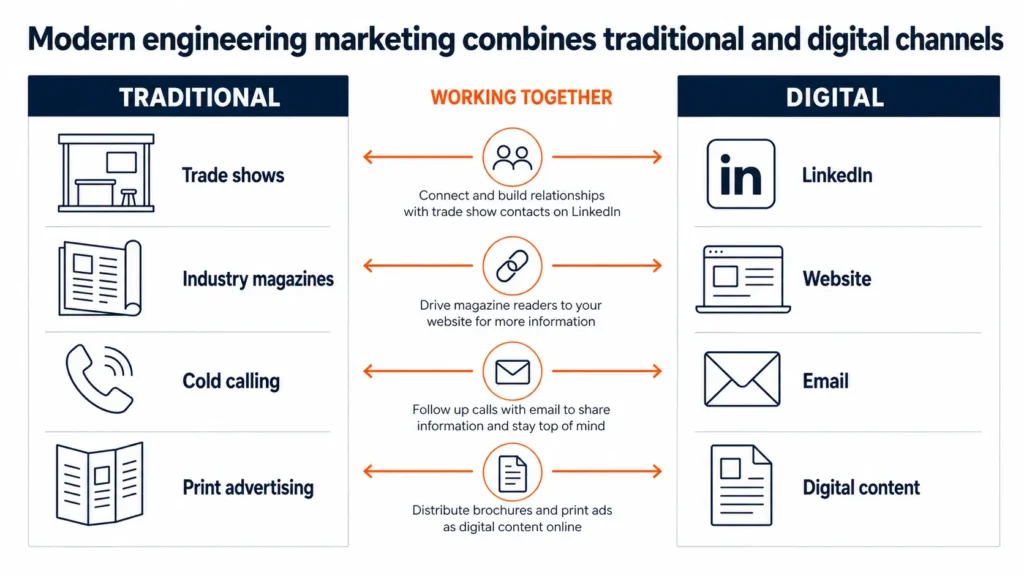
Combining traditional marketing with digital
Although the old methods – trade shows, engineering magazines, print advertising, cold calling – seem less effective than they once were, it’s not a good idea to discard them totally. A modern engineering marketing strategy will support these methods with digital marketing channels. For example:
- Connecting with buyers from trade shows on LinkedIn so they see quality content over time
- Linking your well-designed website in the industry magazine advert so viewers can learn more about your business
- Shifting your printed brochures to digital to widen reach and ease-of-access
- Cold calling those that engage with the content to encourage warmer conversations
Supports buyers who independently research
B2B buyers now complete around 70% of their research before contacting sales, and 80% of the time it’s the buyer who initiates first contact (Demand Gen Report, 2024). Old marketing strategies based on relationships and in-person networking miss this entire stage of the buyer journey.
Modern strategies should support this research phase by providing consistent high-quality, informative content. This ensures your buyers can find answers to any objections they have even when you’re not in the room with them.
Builds trust before contact
A modern strategy doesn’t wait for customers to ask “who have you worked with in the past?”, instead it provides that information up front in the form of detailed case studies. Engineers want to see hard numbers – reduction in downtime, return on investment, lifespan improvements.
Making these trust signals widely available shows you’re confident in your work and willing to be open about results.
Marketing channels that work for engineering
Website design
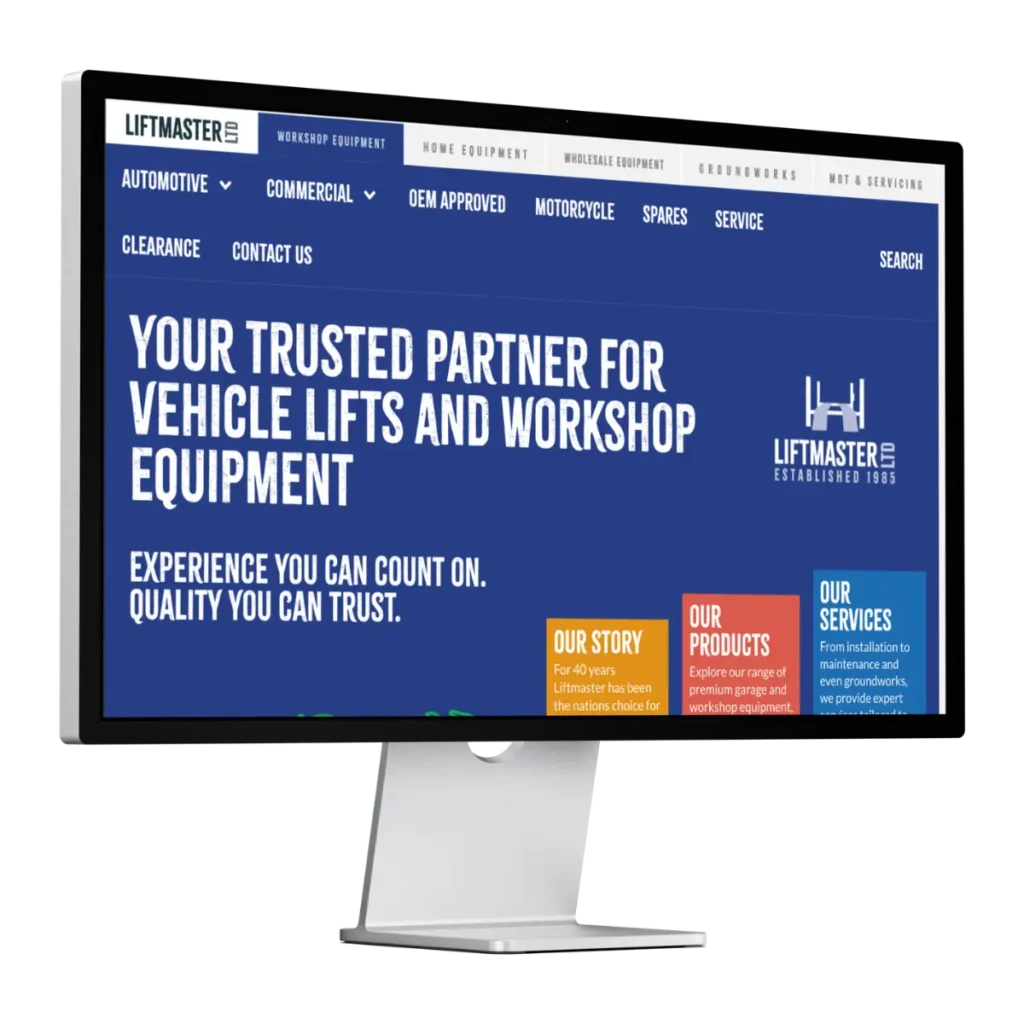
Your website is the hub that every other channel points toward. Trade show prospects, LinkedIn viewers, Google searchers – many of them will end up on your site before they enquire. It needs to do the selling.
- Bespoke design that stands out from the sea of generic engineering websites
- First section should make it instantly clear who you serve and what problem you solve, e.g. “We help UK manufacturers avoid breakdowns through fluid management systems”
- Dedicated pages for every service and industry you serve, optimised around the terms your buyers actually use
- Clear call to action tied to a low-risk offer (consultation, audit, trial), repeated wherever a visitor might be ready to move
- Reviews, ratings, testimonials, and case studies throughout — in engineering, trust signals do more heavy lifting than almost any other element
Read more: website design for engineering companies
Good for: every engineering business. This is the foundation every other channel relies on.
SEO for engineering companies
Engineering buyers start on Google. Search volumes are low, but the intent is high – a buyer searching “precision machining subcontractor” is unlikely to be browsing – they’re ready to enquire, so it’s worth money to be present when the search results appear.
- Build dedicated service and industry pages optimised around the terms your buyers actually use
- Target long-tail, problem-led queries like “how to reduce vibration in rotating equipment” rather than competitive head terms
- Back up technical pages with case studies and supporting content to build topical authority
Read more: SEO for engineering companies
Good for: long-term lead flow, bottom-funnel demand capture, lower ongoing cost once ranking.
Content marketing
Engineering buyers do most of their research before ever contacting you. Strong content answers their questions in your absence and makes the eventual sales conversation easier. Write:
- Technical articles that address specific problems buyers face
- Case studies with real numbers: percentage improvements, cost savings, lead times
- Process explainers that show how you actually work
- Comparison guides between materials, methods, or approaches
Good for: lower budgets, building trust, supporting long sales cycles, feeding every other channel with material.
Google Ads and pay per click (PPC)
PPC puts you at the top of Google immediately while SEO catches up. Useful when you need leads now, not in six months.
- Target a tight set of high-intent keywords, not broad terms
- Use negative keywords aggressively to filter out students, researchers, and irrelevant sectors
- Send traffic to purpose-built landing pages, not your homepage
- Monitor weekly – PPC burns through budget fast if left alone
Good for: fast results, testing new markets, filling gaps while SEO builds. Not good for tight budgets.
Senior engineering buyers are on LinkedIn. Consistent posting keeps you visible to the right people over the long sales cycle.
- Mix project shots, staff insights, technical breakdowns, case studies, and company updates
- Use text, imagery, carousels, and video to keep engagement varied
- Connect with decision-makers in your target sectors and engage with their content
- Aim for steady visibility with the right audience, not viral reach
Good for: long-term awareness, nurturing buyers through long cycles, warming up prospects before sales calls or trade shows.
Email marketing
Engineering sales cycles run for months or years. Email keeps you in front of prospects during the wait, so when they’re finally ready, you’re the name they remember.
- Offer something genuinely useful to get the sign-up: a technical guide, spec checklist, or comparison document
- Send content that’s worth reading, not constant pitches
- Segment by industry or service where it makes sense
- One strong monthly email beats four weak ones
Good for: nurturing existing interest, staying visible during long decision cycles, getting more value from leads you already have, lower budgets.
Trade shows and in-person events
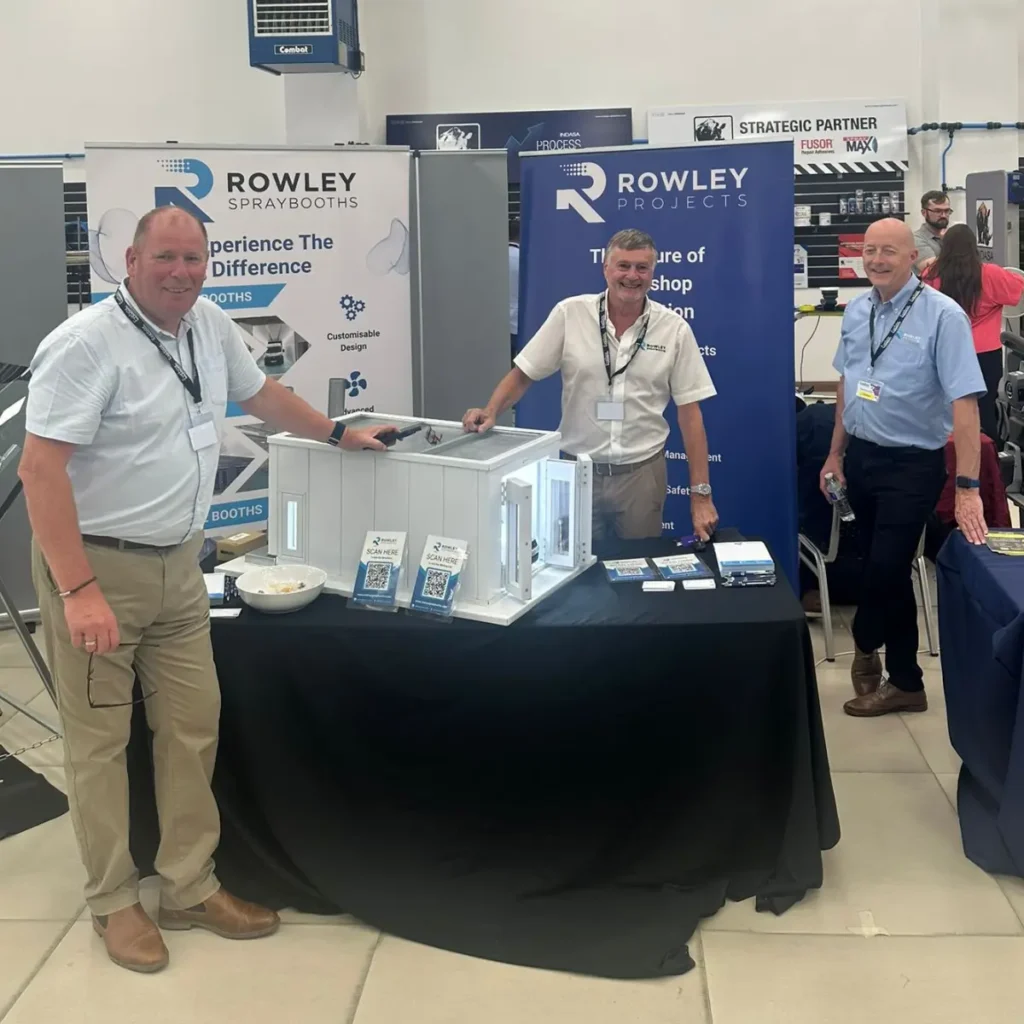
Engineering is still an industry where face-to-face matters. The firms getting returns from trade shows are the ones combining them with a proper digital follow-up.
- Push LinkedIn content before the event so attendees already know you
- Focus on quality conversations, not collecting business cards
- Connect with everyone you spoke to on LinkedIn afterwards
- Use email and LinkedIn content to keep working the connections for months
Good for: building trust at pace, reinforcing existing digital presence, markets where in-person credibility still carries weight.
AI visibility (Answer Engine Optimisation)
Engineering buyers are increasingly using tools like ChatGPT, Claude, and Gemini to research suppliers. These tools give users a shortlist of companies before they’ve even visited a website, so if you’re not being cited, you’re invisible at the earliest stage of the buying process.
- Write content that directly answers the specific technical questions your buyers ask, with a clear, concise answer in the opening paragraph
- Use structured content – clear headings, short paragraphs, bullet points – that AI tools can easily parse and cite
- Target long, question-style queries like “what’s the best material for high-temperature seals” rather than short head terms
- Build topical authority around your niche so AI tools associate you with a specific area of expertise
- Keep your website fast, technically clean, and well-structured so crawlers can access your content
Good for: staying ahead as buyer behaviour shifts, reaching buyers earlier in their research, firms who already have good SEO foundations to build on.
Outbound marketing
Inbound marketing waits for buyers to come to you. Outbound puts your message directly in front of them, whether they’re looking or not. For engineering companies, outbound is useful when you know exactly who you want to reach and you can’t afford to wait for them to find you.
- LinkedIn ads – the best paid channel for B2B engineering. Target by job title, company size, and industry to put your content in front of specific decision-makers. Works well for promoting case studies, gated content, and service pages.
- Meta ads – cheaper clicks than LinkedIn, but audience targeting is broader and less precise.
- Cold email – direct outreach to named prospects at target companies. Effective when paired with a clear, specific offer rather than a generic “let’s chat” message.
- Direct mail – still useful for high-value accounts. A well-designed physical package to a named engineering director cuts through when their inbox is already full.
- Cold calling – calling your ideal prospects and directly asking if you can solve their problems.
Good for: reaching specific target accounts, generating leads quickly, businesses with a tight niche and a clear ideal customer. Best outsourced to a professional so not good for low budgets or firms without a clear target niche.
Step 1 – Define your customer, goals, and budget
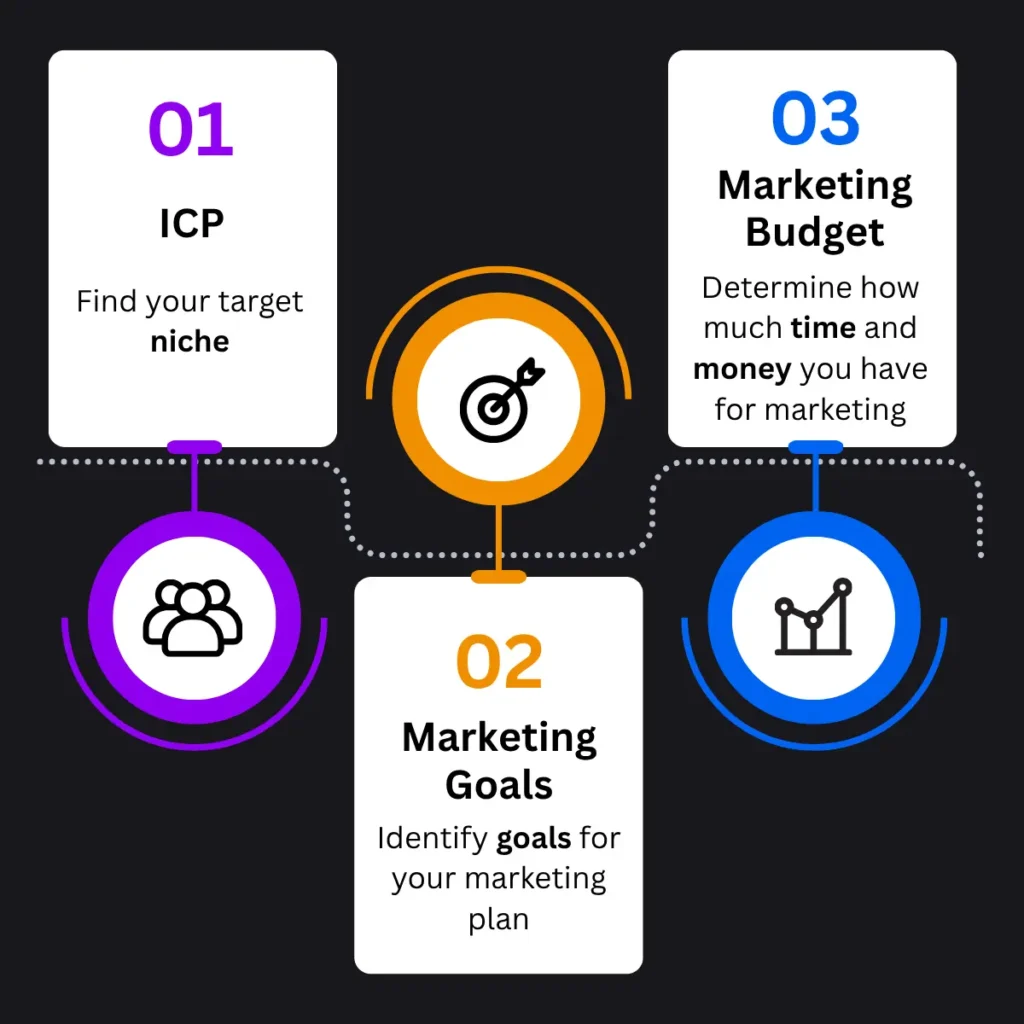
Before building a marketing strategy for an engineering company, you need to be clear on three things: your ideal customer, your goals, and your budget. These factors determine which of the channels above will work best for you.
Niche and ideal customer
As a business, it’s okay to be a specialist in a particular service. But in the digital marketing space, unless you are a large-scale company with an abundance of resources to throw into sales and marketing, without a niche you will be too generalist to target anybody effectively.
Engineers often serve various industries – automotive, construction, aerospace, manufacturing, energy – and each industry searches differently, has different problems, and requires different messaging. The niche you target will determine the marketing channels and strategy used to reach those customers.
Establish which industries, products, or services are most profitable for you, then put yourself in the shoes of a key decision-maker from that business:
- What problems do they have?
- How do they find answers for them? (Google, social media, AI)
- What words would they use to describe your product or service (important for keyword targeting later)
- Do they know they have a problem that needs to be solved, or do they need to be made aware of it? (determines whether SEO will work)
- What part of the solution do they care about the most? (if you target finance directors in construction companies, they might care most about reducing overall project costs)
Marketing goals
What’s the ideal result of your marketing efforts?
- More direct sales
- Sell a retainer-based service over a longer period of time
- Support sales with extra material
- Make people aware of a problem you solve?
We will cover how your goals translate into strategy in Step 3 below. But it’s important to keep it in mind for now as you read on.
Marketing budget
We will list many marketing services, all of which have a place in most marketing strategies for engineers, but your ability to employ them will come down to budget – time and money.
- How much time do you and your staff have available to implement these channels consistently?
- How much money do you have to both:
- Pay for services if you don’t have time in-house?
- Spend on budget (for ad spend, content creation, etc.)?
Budget will determine the scale of your marketing setup.
Step 2 – Determine your positioning and messaging
Positioning is the space you claim in the market. Messaging is how you put that into words your buyers actually respond to. The two are closely linked, but they do different jobs.
Positioning
Your positioning is how you set yourself apart from your competition. In an industry where buyers are risk-averse, and are accustomed to the standard engineering messaging around ‘quality’ and ‘speed’, you want to clearly differentiate your business from the generic competition (or else you’ll be compared on price alone).
Strong positioning usually combines:
- The specific industry you primarily serve (construction, automotive, aerospace, etc.)
- The specific service you specialise in (fabrication, consultancy, installation, etc.)
- The specific project type you focus on (high-volume vs bespoke, large-scale vs precision, etc.)
The more specific you can be, the easier it becomes to stand out. A generic “engineering services” firm competes with thousands of others, but a “precision machining subcontractor for aerospace prototypes” competes with a handful.
Messaging
Once you’ve decided on your positioning, messaging is the central story you tell about your business. It usually answers: who is this for, what problem does it solve, and what makes it different.
For an engineering firm that might be something like “we help UK manufacturers reduce downtime through predictive maintenance systems”. That single sentence then shapes everything else – your website copy, your LinkedIn content, your sales conversations, your ad campaigns.
Below are the principles that make engineering messaging actually land.
Lead with what your customer cares about
Different buyers care about different outcomes. Before writing any content, work out what your ideal customer values most:
- Low prices
- Fast turnaround
- Long-term reliability
- Exceptional quality
- Reduced risk
- Technical capability
Lead with whatever matters most to them. If you target finance directors at construction companies, cost reduction goes first. If you target heads of engineering, technical capability and reliability go first.
Explain why, not just what
Instead of listing the services you offer, explain when and why someone would hire you for them. “Coolant provider” is what you do. “Coolant management services that increase tool lifespan and save money over time” is why someone should care.
This positions you as the solution to a specific problem your buyer is trying to solve, rather than just another service provider.
Translate technical language into value
Technical buyers care about the nuance, but to grab their attention in the first place they need to see demonstrable value first. Does your solution save money, time, or risk?
Hook your audience with the value, then convince them with the technicalities.
Back your claims with data
Engineering buyers value proof and numbers over abstract claims. Specific figures – “40% reduction in downtime” or “£50k saved over two years” – always beat vague claims like significant improvements.
Pull these numbers from real client work. Even better, build them into detailed case studies that show the full picture: the problem, your approach, and the measurable result.
Step 3 – Choose your channels
Here we will list the channels that best suit the different kinds of circumstances that engineers could be in based on the definition of the customer, goals, and budget that we defined earlier.
If you’re just getting started and on a low budget, stick with one or two channels and do them consistently. Add or outsource more over time as you see success.
Note: these are just suggestions, there’s no way to properly recommend channels for your particular business without understanding it first.
- “Low budget” assumes an outsourcing budget of < £1000 per month and not much time to learn and execute more complex services in-house.
- “Medium budget” assumes the £2000 – £3000 per month range.
- “High budget” assumes anything beyond £3000.
These recommendations can go further as you allocate more money to marketing. We are only recommending the most essential services at these price ranges. If you’d rather talk it through, we offer a free marketing strategy session – we’ll recommend a marketing plan for your engineering company based on your specific business.
I want leads fast
Low budget — Cold outreach + LinkedIn
While cold calling is a highly skilled discipline and worth outsourcing to an experienced sales rep, it can be done on a budget if you have the time in-house.
Combining regular posting on LinkedIn with direct outreach to ideal customers can also get you into conversations with prospects very quickly.
Medium budget — PPC + LinkedIn outreach
Pay per click is not cheap to run well (ad spend + outsourcing), which is why you need a decent budget for it, but it’s unmatched for its ability to bring leads in quickly.
Pair it with consistent LinkedIn outreach to make sure you’re capturing both buyers actively searching and those you can reach directly.
High budget — PPC + LinkedIn ads + outbound team
PPC brings in those actively searching, LinkedIn ads put you in front of named decision-makers based on job title and industry, and a dedicated outbound team (in-house or outsourced) works through your list of target accounts.
Done well, this combination produces a steady volume of qualified leads within weeks rather than months. Done badly, it burns through budget faster than any other approach in this guide, which is why most engineering firms running this setup work with a specialist engineering marketing agency or hire experienced people to manage it in-house.
I want a long term lead pipeline
Low budget – LinkedIn + email
Create an appealing offer on the website which provides value to users in exchange for their email address, promote and link to the offer from social media, then funnel those emails into an email marketing campaign.
Combined with regular posts on LinkedIn, this acts as a great long-term lead nurturing strategy on a low budget.
Medium budget — LinkedIn, email, content, light SEO
Either done in-house or outsourced to an agency, adding content marketing and basic SEO (optimised product or service pages and technical audit) can rank your website for hundreds or thousands more high-intent searches over time.
High budget — LinkedIn, email, content, full SEO
A full outsourced SEO retainer including technical SEO, on-page SEO, content optimisation, and backlink building is the best way to bring in leads long-term. As time goes on, your website will increase its authority in your niche and rank better for more searches, bringing in more and more traffic.
My buyers aren’t actively searching for what I sell
Low budget – LinkedIn + cold outreach
If there are no searches for your products and services, it’s likely that your buyers are either problem-unaware, or solution-unaware. You will have to educate them on the problem they have and the solution you provide before bringing them into your sales pipeline.
This can be done cheaply through:
- Posting educational LinkedIn content and building your audience so you can reach your prospects
- Cold outreach to pose the problem to your prospects and talk through the solution
Medium budget – LinkedIn content, LinkedIn/Meta ads, content marketing
Putting more time into creating quality content and distributing it to prospects, and spending more money on LinkedIn or Meta ads to target specific audiences will make more prospects aware of the problem your business solves and bring more buyers into the pipeline.
High budget – LinkedIn ads + organic content + PR + outbound team
- LinkedIn ads put you in front of named decision-makers with content that introduces the problem rather than pitching the solution.
- Organic LinkedIn keeps you visible between campaigns.
- PR adds credibility through trade publications and industry sources.
- A dedicated outbound team works the target list with educational outreach.
This setup educates a market that isn’t searching yet. It takes patience and disciplined messaging across all four channels, which is why most firms running this setup work with a specialist agency.
I’m not getting found on Google
Low budget — SEO targeting long-tail keywords
Long-tail keywords are longer, more specific search terms with lower competition. Instead of fighting for “engineering services” (where you’ll never rank), you target terms like “precision machining subcontractor for aerospace prototypes” – fewer searches, but the people searching are exactly your buyers.
A low-budget SEO programme focuses on optimising your existing service and industry pages around these terms, plus writing a small number of targeted articles answering specific buyer questions.
Medium budget — SEO + content marketing + AI visibility
At this level, you’re investing in proper content production alongside SEO. That means publishing technical articles, guides, and case studies that build your topical authority over time. Google ranks pages it sees as authoritative on a topic, and that authority comes from consistent, high-quality content.
AI visibility piggybacks on the same work. Tools like ChatGPT and Perplexity cite well-structured, expert content when answering user questions, so the same articles working for SEO are also feeding AI search results.
High budget — SEO + content + PPC + AI visibility
Adding PPC bridges the gap while SEO catches up. SEO can take six months or more to deliver real traffic, but PPC puts you at the top of Google for high-intent search terms immediately. The two work together – PPC for short-term lead flow, SEO and content for long-term authority that compounds over time.
This combination turns Google into a reliable lead source. It’s also where AI visibility starts compounding properly, because the depth of content you’re producing for SEO becomes the same content AI tools cite.
Summary
| Low budget | Medium Budget | High budget | |
| I want leads fast | Outbound (in-house)LinkedIn | PPCLinkedIn | Pay per clickLinkedIn AdsOutbound Team |
| I want a long term lead pipeline | LinkedInEmail | ContentLinkedInEmailLight SEO | ContentLinkedInEmailFull SEO |
| My buyers aren’t actively searching for what I sell | LinkedInCold Outreach | LinkedIn ContentLinkedIn AdsContent | LinkedIn AdsContentPROutbound Team |
| I’m not getting found on Google | Long-tail SEO | SEOContentAEO | SEOContentPPCAEO |
Step 4 – Start and implement consistently
A marketing plan for an engineering company compounds over time, which means consistency matters more than channel choice. The biggest mistake engineering firms make is running a strategy for two months, deciding it didn’t work, and pulling the plug right before it would have started paying off.
Begin with the website and SEO optimisation
As most traffic will visit or flow through your website, upgrading it should be your first priority. Go through the requirements in the web design section and ensure that your website meets the criteria listed.
If you’re running SEO, optimise your website content to rank for terms your prospects search for.
Build content and configure advertisements
Start writing the useful content we covered in the services section and begin drafting your social media posts.
Configure your Google/LinkedIn/Meta advertisements and build any landing pages needed.
Ongoing – optimise campaigns, post content, conduct cold outreach
Now continue to implement your strategy regularly:
- Regularly check your Google Search Console to see website traffic and rankings
- Check ad performance and adjust the configuration as needed
- Continue creating content and posting on social media
- Conduct outbound to high-value prospects
This step is the most important by far. Without consistency, your marketing plan won’t work and you may have wasted a lot of time and energy.
Where most engineering companies get their strategy wrong
These are the patterns we see most often when reviewing marketing strategies for engineering companies. None of them are hard to fix once you spot them.
Treating marketing as a one-off project
Engineering marketing compounds over months and years, not weeks. Firms that run a six-month campaign, decide it didn’t work, and pull the plug almost always quit just before it starts paying off. If you don’t have the time to implement your marketing consistently, consider outsourcing it to an engineering marketing agency.
Trying to market to everyone
Generic positioning aimed at “all manufacturers” or “any engineering firm” makes you invisible. Unless you’re a massive company able to compete with the biggest companies in the world, you’ll yield better results from targeting a niche.
Ignoring LinkedIn
Engineering decision-makers are on LinkedIn, but most engineering firms either don’t post at all or post sporadic company updates that nobody engages with. Consistent, useful content from the people actually doing the work is the version that builds trust.
Relying entirely on referrals
Referrals are the best leads you’ll get, but they’re unpredictable and don’t scale. Firms with no other lead source have nothing to fall back on when referrals dry up.
Treating the website like a brochure
A website that just lists services and contact details isn’t doing any work. A website that explains who you serve, what problem you solve, and includes proof in the form of case studies and reviews actively generates enquiries.
FAQ
What is a marketing strategy for an engineering company?
A marketing strategy for an engineering company is a plan that combines the most effective channels for generating leads and revenue from technical buyers. Unlike generic B2B marketing strategies, an engineering marketing strategy accounts for longer sales cycles, technical decision-makers, low-volume but high-intent search behaviour, and the importance of trust and proof in the buying process.
What does a marketing plan for an engineering company include?
A typical marketing plan for an engineering company includes a defined ideal customer, clear positioning and messaging, a chosen mix of marketing channels (such as SEO, content, LinkedIn, PPC, and outbound), a budget allocation across those channels, and a measurement framework for tracking leads and ROI. The most important factor is matching the channel mix to your specific goals and budget.
What are the best marketing strategies for engineering companies?
The best marketing strategies for engineering companies depend on your goals, budget, and how your buyers currently find suppliers. SEO and content marketing work well for long-term lead generation. PPC and outbound work well for fast results. LinkedIn works for almost every engineering business because that’s where technical decision-makers spend their time. Most successful engineering firms run two or three channels in combination rather than relying on a single approach.
How is B2B marketing for engineering companies different from B2C?
B2B marketing for engineering companies sells to a buying committee of multiple stakeholders – engineers, procurement, finance, operations – over weeks or months, while B2C sells to one person in minutes. That difference shapes everything: the channels you use, the content you produce, the messaging you write, and the length of your sales process. B2B engineering marketing focuses on building trust, demonstrating technical credibility, and staying visible across long decision cycles.
How much should an engineering company spend on marketing?
There’s no fixed answer because it depends on your goals, your sales cycle, and the channels you choose. As a rough guide, B2B engineering firms typically allocate between 5% and 15% of revenue to marketing, with newer or fast-growing businesses sitting at the higher end. The more important question isn’t how much you spend, but whether the spend matches the goal. Wanting fast leads on a low budget rarely works. Wanting a long-term pipeline with patient investment almost always does.
How long does it take for an engineering marketing strategy to deliver results?
It depends on the channel. PPC and outbound can produce leads within days or weeks. Content marketing and SEO usually take three to six months to gain traction and twelve months or more to compound into reliable lead flow. LinkedIn sits in the middle – early engagement within weeks, meaningful pipeline impact within three to six months. Engineering firms expecting fast results from long-term channels (or vice versa) almost always quit before they pay off.
Should engineering consulting firms have a different marketing strategy?
Yes. An engineering consulting marketing strategy looks slightly different from a product-focused engineering firm. Consulting buyers are buying expertise rather than a tangible product, which makes thought leadership content, LinkedIn presence, and case study evidence more important than SEO for product-specific keywords. Most engineering consultancies do best with a strategy weighted toward content, LinkedIn, and PR – channels that build authority over time.
Ready to put a strategy together?
Building and running an engineering marketing strategy takes time, technical understanding, and consistency over months and years – three things most engineering MDs don’t have to spare. If you’d rather have a team handle it for you, we’re an engineering marketing agency built specifically for this. We’ll put together a strategy based on your goals, budget, and ideal customer, then run the channels that fit. Book a free strategy session and we’ll talk through what would work best for your business.